Sunday, January 15, 2012

Bible Study


"It's raining," the Reverend Calvin Johnson said, and smiled, while standing on my front porch, dripping wet in a sudden downpour, a picnic basket slung over his right forearm.
"How can you tell?" I laughed and opened the door wider to let him into my house. "Put the basket on the kitchen table. I'll get a towel."
I fetched a white Turkish towel from the bathroom, hurried back to the kitchen, and handed it to him. "Forget your umbrella?"
He laughed, a deep laugh with another warm, blue-eyed smile attached. "It wasn't supposed to rain," he said, wiping his head, face, arms, and hands. "Not today."
He was the new minister at our church—tall, with blonde wavy hair. I first saw him five Sundays ago in church, when our retiring pastor introduced him from the pulpit. My widowed mom, leaned close to me in our pew, and whispered, "My, I've never seen such a handsome minister."
After the service, I officially met Reverend Johnson in the church basement at a reception to honor our retiring pastor and to welcome our new one. When Reverend Johnson and I were introduced, we gripped hands to shake, and my heart thudded crazily because for some reason his magnetic blue eyes locked with mine. I gulped. "Dr. Theresa Campbell," I said, as our hands pumped twice.
His head tilted. "The only dentist in town, I've heard."
"That's right—Rapid Falls' only dentist."
"Upper right," he said, pointing to his cheek. "Way back."
"Might be a molar."
Two days later, I pulled Reverend Johnson's ailing tooth—painlessly, I might add; he thanked me profusely. Then he said I could call him Cal, instead of Reverend Johnson and asked if he could call me Theresa instead of Dr. Campbell.
I said that was fine, and I couldn't believe what I was thinking. He was single. I was single. Neither one of us had ever married. We were exactly the same age. Thirty-eight.
Then: Stop it, Theresa! I told myself. He's a man of the cloth.
And that's what frightened me.
Quaint and quiet as this little town is, it's filled with gossiping tongues. Can you imagine how rumors would fly if the new pastor and the old-maid dentist were...well, even seen together in public? Holding hands could probably ruin our reputations.
Telephone calls, text messages, and emails between Cal and me followed his office visit. I learned that after ordination, Cal spent ten years in the service as a U.S. Navy chaplain, rising to the rank of Captain. He'd spent the last two years in Casper, Wyoming, as an assistant pastor. Now he'd come to our little town as pastor.
 I poured out my own story. Dental school at State College. Then I returned home to practice dentistry with my dad, until he died. I even told him about Roy—my high school and college sweetheart, who left town five years ago with someone else.
Cal handed the towel back to me now, and I draped it over a kitchen chair. "Our first date," he said, "—we're washed out. And I thought your idea of a picnic on a Sunday afternoon was such a great one."
I frowned. Cal and I were in a dicey situation. He had wanted to go to a movie this afternoon and then to dinner later; but—call me silly, if you want—I was afraid for us to be seen together. Too many wagging tongues in this town. Maybe after he'd been a pastor here for six months or so. Then maybe...
"Don't frown like that," he said. "We can move the coffee table in your living room, spread the table cloth on the floor, and still have our picnic—it's all in the basket."
"But your red Jeep," I said, "is parked in front of my house. People will drive by..."
Now it was his turn to frown.
"I don't want anybody to misjudge you," I said. "You're very important to this community." I held my breath before I said the rest: "And you're becoming very important to me."
While my heart fluttered, he stared at me. "Do you have a Bible?" he asked.
"Why, yes. Of course..." I fetched my Bible from the night table drawer in my bedroom, returned to the kitchen, and handed him the book, wondering what was next.
"First of all," he said, "all any of us need worry about is the Lord's judgment. And secondly"—he opened the picnic basket and pulled out a red-and-white checkered tablecloth—"if anyone asks why my Jeep was parked in front of your house, we'll tell them we had a picnic on your living room floor. And later we studied the Bible."
I smiled at that. I'd never had a picnic in the house, and I hadn't really studied the Bible since I was a kid. I couldn't wait.

The End
Enjoy Reality! Contemporary Fiction with an impact. Visit: http://www.amazon.com/s/ref=nb_sb_noss_1?url=search-alias%3Dstripbooks&field-keywords=Jon+Ripslinger




Saturday, December 31, 2011

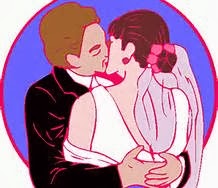
A New Year's Eve Kiss

 "I'd like to kiss you at midnight," a handsome man with incredible brown eyes said.  He peered at his watch. "Not a lot of time left. Half hour."
As I glanced up at him from my table in the Starlight Ballroom, a wide smile curved his lips. Ordinarily, I'd be alarmed at such a request coming from a stranger, no matter how handsome. But this was New Year's Eve. Party time—music and dancing, laughing and kissing.
But tonight my date had walked out on me. "Just spotted an incredible long-lost friend," my date had said, dropping a fifty-dollar bill on the table. "For drinks and cab fare. I don't think I'll be back."
And with that I was left sitting alone at a table, red-faced, humiliated, and angry. Maybe a midnight kiss from a stranger is what I needed—a boost to my damaged ego. But I didn't feel like staying at this party—a thirty-year-old woman by herself. And I certainly didn't feel like kissing a stranger.
"I don't think there's a kiss in our future," I said.
"May I sit down?" the man asked, his voice soft and warm. "Please? Looks like your drink needs freshening."
"You may sit," I said. "But I'm leaving." I brushed the fifty-dollar bill toward him. "If a waiter comes by, tell him that's his tip."
The handsome man pulled out the chair across from me where my date—Eddie—had sat five minutes ago. Easing himself into the chair, the stranger picked up my glass, studied it, then sniffed. His left eyebrow cocked. "It's not wine. Not champagne."
"Ginger ale with a twist of lemon," I said, and shoved my chair back, ready to stand. "I'm a teetotaler tonight."
"I saw what happened."
I blinked. "What happened?"
"The man you were with—I saw both of you talking furiously. Arguing maybe. And then he got up and left."
My eyes dipped. Heat flooded my face. I lifted my gaze and studied his handsome face. Soulful eyes, dark-brown hair cut just a little long, square-jawed—a man like this shouldn't be running loose tonight. He must have a girlfriend or a wife here somewhere. "Do I look so alone and out of place," I asked, "that you're offering me a charity kiss?"
"Your boyfriend," he said calmly, "just left with my date. I watched them go out the door."
I froze. For a second, I couldn't hear the music in the background or the laughter and chatter. I lifted my chin and said, "He's not my boyfriend. I met him three weeks ago. Blind date. This is the second time we'd gone out."
The handsome man shrugged. "I'm sorry. Would you like to dance while I explain what I know?"
When he gently took me into his arms on the dance floor, my heart triple-timed; I forgot about being humiliated and embarrassed. The music was fast, sometimes bouncy, but we danced slowly. He said his name was Troy Hamilton. I told him mine—Jodi O'Donnell.
His date was a friend—Liza—who worked in his office; they sometimes escorted each other to parties and banquets so as not to feel awkward and alone. Turns out my date and his date knew each other from long ago in college. Later, they joined the Peace Corp together but became separated and eventually lost touch. Tonight they'd rediscovered each other in the ballroom. "I think they've been searching for one another for ages," Troy concluded.
"And they found each other tonight?"
"I know. Weird, huh? Life is sometimes stranger than fiction."
"Unbelievable."
I discovered Troy and I had more than our dates in common. Books. He was purchasing agent for our school system; I was a middle school reading specialist. I wanted to thank him profusely for not cutting library funds. But before I could say anything, the music stopped; someone started the traditional New Year's Eve countdown: "Ten, nine, eight..."
He looked down at me with those deep-brown eyes. Oh my gosh! Is he actually going to kiss me?
"...five, four, three..."
He drew me closer into his arms. His lips landed on mine, and my heart cartwheeled. "Happy New Year!" rang throughout the crowded ballroom. When we released each other, he said with a touch of shyness, "I hope I didn't offend you."
I swallowed. "New Year's Eve—everyone kisses somebody."
We ambled to our table and sat down. "Night's young," he said. "You still going to leave?" He offered another shy glance. "That wasn't a charity kiss. How about another ginger ale with a twist of lemon?"
For a moment, I didn't know what to say. His date, my date—his kiss—I couldn't believe any of it. I swallowed again. "I'd love a rum and Coke."
He smiled. "That's more like it."
I smiled back and handed him the fifty-dollar bill still on the table. "Let's really celebrate on Eddie and Liza."
The End
Welcome to reality! Contemporary YA fiction that'll rock your heart. Don't wait! Visit: http://www.amazon.com/s/ref=nb_sb_noss?url=search-alias%3Daps&field-keywords=jon+ripslinger


Thursday, December 15, 2011

A Tree for Christmas


          I didn't know how I was going to get through the holiday season this year—I hadn't even looked for a tree.
My husband had died five years ago. I'd learned to deal with that, but my daughter, away at State University, suddenly seemed so independent she no longer needed me. Looking for a shoulder to cry on, I called my sister Celia a week before Christmas and told her my sob story: My daughter Ashley had called and said, if I didn't mind, she'd like to go home with a friend just until after Christmas Day.
Please, Mom! She'd spend all the rest of her holiday with me.A young man was involved. Someone "very special."
"Didn't you tell her," Celia wailed over the phone, "that she was leaving her forty-year-old mom high and dry?"
"I didn't want to ruin her plans—I remember being that age. Being in love."
"Tell you what," Celia said. "Why don't you help me this week?"
Celia spent a lot of time during the week before Christmas at the Children's Hospital, delivering little gifts she purchased during the year from a novelty store. She and her husband had lost their only child to leukemia. The boy had spent a long time in the hospital, and this was Celia's way of cheering up other youngsters who were ill. I told her I'd be delighted to help.
During that week, in the afternoon, Celia and I sported Santa hats—hers red, mine green—and delivered tons of little gifts that we each carried in a basket: Christmas pins—angels, Santas, reindeers, snowmen, snowballs. And candy canes tied with a red or green ribbon. Miniature cars, trucks, dolls, dogs, kittens.
Suddenly I felt my own spirits lifting because I was lifting someone else's.
On the third afternoon, just before getting ready to leave the hospital, I sat in the waiting room on the third floor waiting for Celia. She'd gone to the restroom.
While I browsed though a magazine, a tall man with sandy hair stepped into the waiting room. "Nice hat," he said, and smiled.
My heart did a little flip-flop, and my hand flew up to the green Santa hat I wore. I pulled it off. "I'm pretending to Mrs. Claus," I said. "Sort of..."
I felt myself blushing.
"I know. I saw you and your friend yesterday in the first-floor hallway, and today my son said you'd visited him. Room 2030."
I prayed the boy's illness wasn't serious. "His name...?"
"Danny. Danny Wilson," the man said. "He's ten. He has mono—pretty serious—but he's recovering. Though I don't know if he'll make it home for Christmas. It'll be a pretty lonely house without him."
"I know what you mean. My daughter is gone."
The man looked stricken. "I'm so sorry..."
"Off to college," I said quickly, waving a hand. "Not like you were thinking..."
Just then Celia appeared. She smiled at the tall man and they both said hello. I rose and told him I hoped his boy got better soon. As Celia and I left the hospital to get our cars in the parking lot, she told me she knew the man—Patrick Wilson. His family and he had once lived down the street from her. He was a widower. His wife, in her late thirties, had died during childbirth. "He's handsome," she added, pointedly. "Don't you think?"
I wanted to tell her I hadn't noticed. But I opted for the truth. "Very handsome."
I met Patrick again the next day, accidentally. We were both climbing out of our cars in the hospital parking lot, all bundled up because of the cold and snow.
"Where's your buddy?" he said, puffing out a frosty breath.
"Probably waiting for me in the lobby."
"We haven't been officially introduced—I'm Patrick Wilson."
"Ellen Thompson."
"It's a wonderful thing you're doing, Ellen, cheering these kids up during the holidays."
"Thanks. I'm having a lot of fun."
"Watch out!" He gripped my elbow, guiding me around a patch of ice hidden under the light snow that was falling. His touch sent my heart flip-flopping again.
"I'll find out today for sure if Tommy will be home for Christmas—I've got to get a tree tonight. I've been so busy—I manage a furniture store in the mall, and sales are booming."
"I don't have a tree either. Tying it onto the roof of the car, lugging it into the house, getting it balanced in a stand—my daughter always helped me with that."
"Your husband....?"
"I'm a widow. Five years now."
"I'm sorry."
"I'm getting along fine," I said.
Inside the hospital lobby, where I met Celia, Patrick and I parted. But before he stepped onto an elevator, he smiled and waved at both of us.
"I think he likes you," Celia said.
"Don't be silly." But I wondered if it could be true.
After Celia and I finished our rounds, emptying our baskets, we headed for the hospital doors. We both spotted Patrick sitting in a chair in the lobby as if he were waiting for someone.
"He's waiting for you," Celia whispered.
"He is not!" I hissed.
"Why do you think he's sitting there?" She tugged the empty basket from my grasp. "I'm going home. Talk to him." With that she gave me a nudge in the back.
When I approached Patrick, he stood up looking so uncertain I thought something might have happened to Tommy. But he said, "Tommy will be home for Christmas—and I wondered...well, I wondered if we could look for trees together."
I blinked. I was so surprised I couldn't talk for a second.
"I'll help with the lugging and all," he said. "Even the balancing."
I tried to breathe evenly but couldn't. "I'd love to look for a tree."
He smiled at me again. "Nice hat."
But this time I left the green Santa hat perched atop my head. The hat, it seemed to me, echoed the warm holiday spirit I felt bubbling inside myself.

The End
Enjoy Reality! Contemporary YA fiction with an impact. Visit: http://www.amazon.com/s/ref=nb_sb_noss?url=search-alias%3Daps&field-keywords=jon+ripslinger


Wednesday, November 30, 2011

Shave and a Haircut


When the lanky man strolled into my Hair Care Beauty Salon, my head swiveled, and the heads of my two other stylists and their clients popped up. "Oh my!" Mrs. Ellison, the elderly, gray-haired lady sitting at my station said. 
"Such a handsome young man."
"Just a second," I told her. I set my scissors and comb on the sink. I stepped up to the reception counter and said in my most customer-friendly voice, "May I help you?"
The lanky man tried to smile through his scruffy beard and mustache. "Umm...I found your salon listed on the Internet." He cleared his throat. "I'm checking...you participate in the Locks of Love program?"
"Yes, of course," I said. "We cut hair, bundle it properly, and send it on so it can be made into a wig for youngsters who have lost their hair. For whatever reason."
His deep brown eyes turned solemn. "My niece—my sister's little girl—may be in need. She's eight."
"Oh no! I'm so sorry."
"Just checking..." At this point, the lanky man flipped the longest ponytail I'd ever seen over his shoulder—beautiful, silky, chestnut-brown hair. "I may want to donate this."
I blinked. "It's certainly long enough. Not bleached. You realize it takes a number of ponytails to make a hairpiece. Your hair mostly likely won't be included in a wig for your niece."
"I understand that."
"You'd like to make an appointment?"
He gave the ponytail and long look. "Two weeks from now," he said. "I'll call to cancel if...if I don't need it cut."
My heart ached for him and his niece. With a deep sigh, I wrote his name into my appointment book—Jeremy Foxx—and we said good-bye.
During the next couple of weeks, I thought of Jeremy. So handsome. Such long hair. His poor niece. Of course I knew why he wanted to donate his hair: If his niece lost hers, he wanted to prove he'd be there for her in every way. I wondered if I'd see him again. I hoped so. But then I hoped not.
My pulse spiked when Jeremy stepped cautiously into my salon at the appointed time. "Shave and a haircut," he said simply.
Once he was seated, I pulled the elastic from his ponytail and braided his luxurious hair. "Ready?" I asked. He gave a nod, and I snipped his ponytail off with two quick strokes. I glanced at him in the big mirror in front of us. "You all right?"
He nodded again, his face expressionless.
"I'll give you a wash," I said. "Then cut your hair short on the sides, a little long on top? Is that all right?"
"Shave it all off," he said. "Beard and mustache, too."
I gulped. "You're sure?"
"Positive."
While I shaved his head, I tried to get him to relax. I told him my name. Patti Albright. I asked him questions about himself. He was an elementary school art teacher. During the summer he worked as a wood carver, sculpting animals—owls, bears, eagles—from tree stumps in people's yards. We were both single. Never married. Doctors feared his niece Lisa had a cancerous tumor on her brain.
When I finished, he stood, scowled at himself in the mirror, and rubbed the top of his head and his chin. "Smooth," he said with a rueful smile.
"You've done a wonderful thing," I said. I forgot to breathe when I added: "With or without hair, you're handsome."
He shrugged sheepishly.
"Call me," I said. "Keep me posted. Please."
He called to say Lisa would have to undergo surgery to remove the tumor. He called again to say that nearly all of Lisa's tumor had been removed but because of its location a bit remained. Doctors were optimistic that with chemo and radiation therapy they could destroy the rest; Lisa's prognosis was good.
I knew that chemo and radiation meant Lisa would definitely lose her hair, and I was delighted to have played a small part in having a wig made for her. My staff and I pooled our money and sent flowers to Lisa in the hospital.
I didn't expect to see Jeremy again. But a week after his last phone call, he appeared at my salon. While my staff and their customers smiled at us, he fished a cell phone from his pocket, clicked a button or two, and said, "Look at this picture."
A grinning Lisa, her head still bandaged, held a chestnut-brown wig in her hand. "She can't wait to wear it," Jeremy said. "And she's expected to recover fully."
"I'm so happy for her. And for you." I glanced at him. My heart danced. Dare I speak?  "Looks like you'll need a haircut soon."
"First how about dinner and a movie over the weekend. We'll discuss it."
I smiled. "A shave, too?"
He smiled back. "All right," he said. "Shave and a haircut. Just for you."

The End

Enjoy Reality! Contemporary YA fiction with and impact. Visit: http://www.amazon.com/s/ref=nb_sb_noss_1?url=search-alias%3Dstripbooks&field-keywords=Jon+Ripslinger


Tuesday, November 15, 2011

Good Sports

           "Do you really like living alone in that little town of Grinnell?" Mom said. "Are you working too hard? Do you have enough fun?"
We were sitting on her deck just off the kitchen of her condo in St. Petersburg, Florida, drinking coffee in the cool morning sunshine, palm trees waving in the background.
"Mom, I have tons of friends in Grinnell, and you know I love my work..."I skipped the part about living alone.Being lonely.
I'd been raised in Grinnell. After dad died two years ago, unable to stand the harsh winters any longer, Mom moved to this retirement community where several of her friends had relocated after their husbands' deaths. This was my first visit.
"We're going to play golf later, Amy."
I frowned. "Mom, I don't play golf anymore."
"You'd be surprised at how many nice people you can meet on a golf course."
She meant how many nice men I could meet. Single men. I'd played golf in high school to please Mom and Dad, but sports simply weren't my thing. Music, art, drama—these were my passions. They made my heart go Bump! But Mom didn't seem to understand that. She and dad had been high school and college jocks.  Football for dad. Golf and volleyball for Mom.
My two weeks with Mom in the Florida sunshine was wonderful, but it ended too soon. The evening before my flight home, Mom's friend from Grinnell, who'd played golf with us, appeared on the porch waving a putter. I'd known her since I was a little girl. "Would you please take this putter back to my son, Amy? It's one of his dad's. A new design. Somehow it ended up in my golf bag when I moved."
 "Sure," I said. "What's his address?"
"I'll have him call you and arrange to pick it up."
The next day aboard the plane, a good-looking guy with curly black hair sat next to me. After the plane was airborne, he said, "You must've played a lot of golf—you have a really nice tan."
"I love the beach," I said. "Plus my mom dragged me around the golf course a lot."
"Do you play well?"
"Not at all."
He laughed. "Lots of women play better golf than men—I've known a few."
Now it was my turn to laugh. "Well, I wouldn't be one of them." We talked about our vacations. He'd been visiting a former college roommate from his football team. Then he told me he was a lawyer.  Single. I told him I was a high school art teacher. Single. I told him I especially loved visiting museums and art galleries. Our little museum back in Grinnell was one of the best in the state. He was a big pro football fan—the Patriots—and hadn't been to a museum since high school.
Oh, well, I thought, when we landed in Atlanta and he had to change flights, it's not like we were meant for each other. And my heart didn't go Bump! when I met him. No passion at all.
My second day home, Charlie Bennett called about his putter.
I told him where I lived and sat on my front porch swing, waiting for him, reading my mail, the putter beside me.
Charlie parked in front of the house and strolled up the walk. He was tall and brown-haired with glasses. Nice-looking. Wavy brown hair. My heart surprised me with a little Bump!
I stood and held the putter out for him. "Your mom thought you might want this."
"I don't play golf," he said, and took he putter from me.
His dark-brown eyes seemed to study me cautiously.
"You probably shoot in the low seventies? Right?"
"I played in high school. I wasn't any good. Never been into sports."
"Then why would your mom—?"
Before I could finish the question, the answer hit me. Charlie had already figured it out. Smiling, he said,  "Meddling moms."
"Oh wow! I can't believe how devious they are."
"Blame my mom," Charlie said. "Last year she sent one of her friend's daughter home from Florida with a tennis racquet for me."
"Really?" I said, laughing.
"I knew all along this was a set up.
I could've told you over the phone to toss the putter. But actually I wanted to meet you. I sort of remember you from when we were kids. Our moms used to take us to the park."
"I don't remember—"
He noticed the flyer for the Young American Sculptors exhibit lying on top of my opened mail on the swing. "I want to see that show," he said.
I'm sure I looked surprised. I felt my eyebrows rising. "Honest? I understand it's going to be a great exhibit. Pieces by some highly talented people."
He cleared his throat. His Adam's apple bobbed. "Would you like to go?"
"I—" My tongue seemed stuck to the roof of my mouth.
"Maybe have dinner first?" he said.
I managed to swallow. "I would," I said, sitting back down on the swing. A little bewildered, I made room for Charlie. "Sit—we need to talk about a few things..."
"Like our busybody moms...and why I like museums?"
"Exactly," I said.
Bump! Bump!